
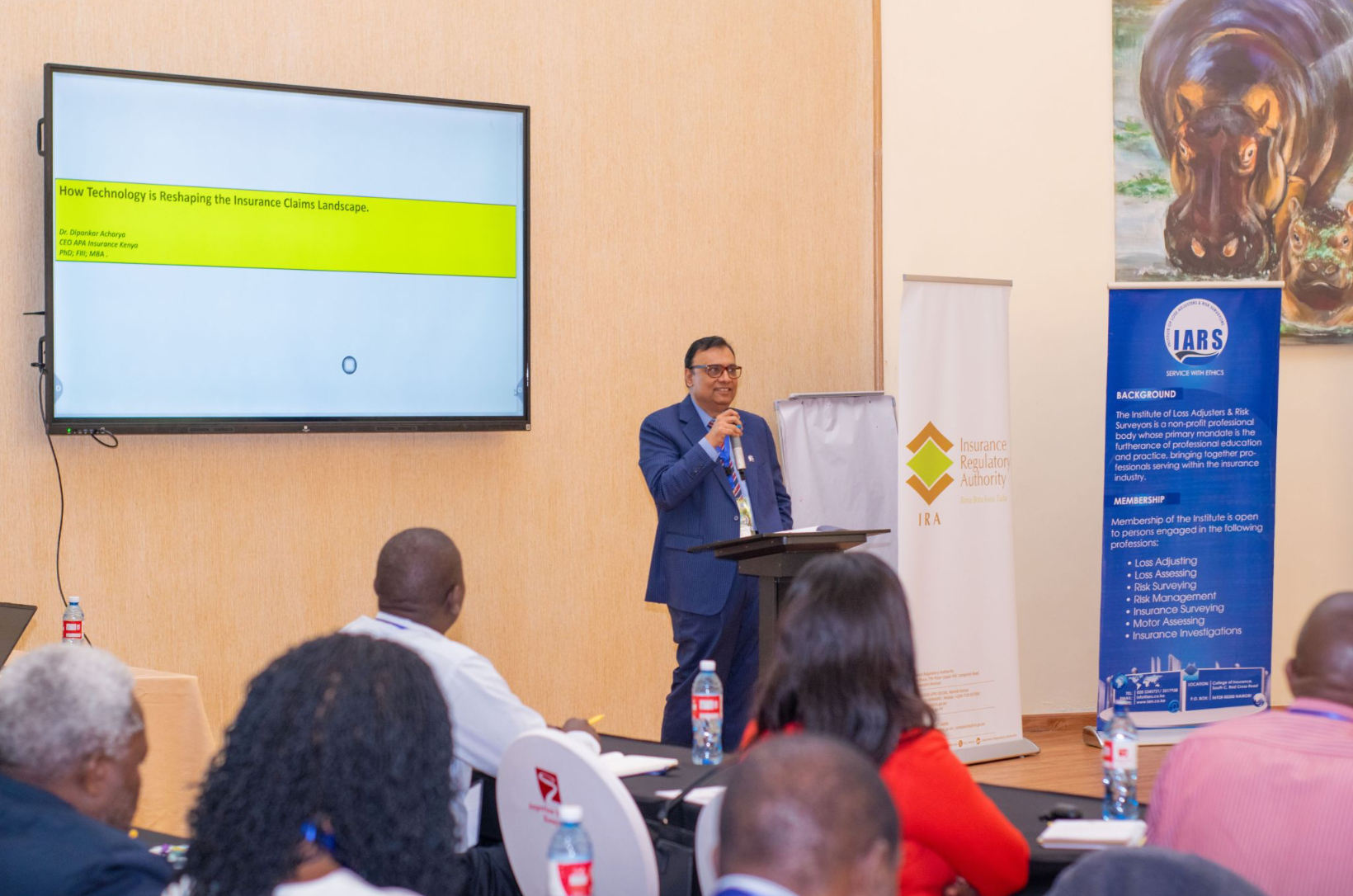

Insights from the 19th IARS Annual Conference | May 2025
The insurance industry is undergoing one of the most significant transformations in its history — a shift driven by artificial intelligence (AI), digital technologies, and data-driven systems that are redefining how risks are assessed, claims are processed, and customers are served.
This article draws from a presentation by Dr. Dipankar Acharya, Chief Executive Officer of APA Insurance Ltd, delivered during the 19th Institute of Loss Adjusters & Risk Surveyors (IARS) Annual Conference held in Naivasha.
In his presentation titled “Embracing Digital Transformation,” Dr. Acharya explored how emerging technologies are reshaping insurance operations and the pivotal role professionals must play in adapting to this evolution.
Technology and Data Evolution
The pace of digital transformation across the insurance sector continues to accelerate.
AI-powered tools, cloud computing, and interconnected devices are generating unprecedented volumes of data — from telematics and drones to IoT sensors and mobile apps.
This explosion of information enables more personalized insurance solutions, dynamic pricing models, and real-time decision-making. For claims professionals, it opens new opportunities for precision and speed — but also demands stronger data literacy and ethical awareness.
Transformation in Claims Processing
In claims management, automation has become a central theme.
Insurers are deploying straight-through processing systems to eliminate repetitive tasks, reduce manual intervention, and accelerate claim settlement times.
AI-driven triage tools can now categorize claims by complexity, identify those requiring immediate attention, and allocate resources more efficiently.
Routine claims can be settled automatically, while complex, high-value, or disputed cases continue to benefit from professional human oversight.
The result is a model that combines efficiency, accuracy, and improved customer experience, while allowing adjusters and claims managers to focus on tasks that demand technical judgment and empathy.
AI and Fraud Detection
As digitalization increases, so does the sophistication of fraudulent activity.
AI now plays a critical role in fraud prevention — analyzing data for inconsistencies, identifying unusual patterns, and flagging exceptional cases in real time.
Machine-learning algorithms can detect anomalies invisible to traditional methods, helping insurers and adjusters prevent financial losses while safeguarding the integrity of the claims process.
Data Processing and Analysis
AI’s analytical capabilities extend far beyond automation.
Modern systems can process both structured and unstructured data, integrating claim forms, photos, videos, and sensor readings into a unified analytical framework.
This enables real-time insights into loss patterns, customer behavior, and emerging risks — supporting more accurate underwriting and proactive risk mitigation.
For adjusters and claims specialists, it means working with richer, faster, and more reliable information than ever before.
Emerging Technology Trends
Looking ahead, several technological trends are set to deepen the transformation of insurance operations:
-
Robotics and robotic process automation (RPA) for repetitive workflows
-
Cross-industry data sharing to improve accuracy in risk assessment
-
Neural networks and predictive analytics to anticipate claim outcomes
-
GPS and telematics to refine personalized coverage and loss prevention
-
Automated risk-monitoring systems offering real-time visibility into insured assets
Together, these innovations point toward a future where 70 – 99 percent of insurance processes may be automated — with human intervention required only for strategic, ethical, and complex decision-making.
The Evolving Human Role
As automation advances, the human role in claims handling is not diminishing — it is evolving.
Professionals will increasingly focus on complex negotiations, strategic oversight, and risk management, while supervising the systems that execute routine processes. The human element — empathy, judgment, and accountability — remains irreplaceable.
Technology enhances these strengths by removing administrative burdens and allowing professionals to focus on the work that truly requires human insight.
Building Technical Readiness
For insurers, adjusters, and regulators alike, this technological shift calls for new skills, new thinking, and structured professional development.|
Technical proficiency in AI, data analytics, and automation tools must now complement the traditional competencies of investigation, quantification, and negotiation.
At Specialty Claims Academy (SCA), we continue to support this transition by developing and delivering training programmes on technology adaptation, data analytics, and digital transformation in claims management.
Through these initiatives, SCA helps insurance professionals and organizations build the readiness and confidence required to thrive in a rapidly changing environment.
Organizations seeking to equip their teams for this future are welcome to engage SCA for tailored workshops, executive briefings, and capacity-building collaborations designed to bridge the gap between technology and technical practice.
📧 training@specialtyclaims.co.ke
🌐 www.specialtyclaims.co.ke
Author:
Fredrick A. Oloo
BCom (Ins.), Dip CII, Dip CILA
Lead Trainer & Director – Specialty Claims Academy (SCA)
( Also: Managing Director – Niche Loss Adjusters & Marine Surveyors Ltd
Council Member, Institute of Loss Adjusters & Risk Surveyors (IARS – Kenya)
Member, Chartered Institute of Loss Adjusters (CILA – UK)’s Future Focus Committee))